Biography of Gabriella Morreale
A life dedicated to endocrinology and public health
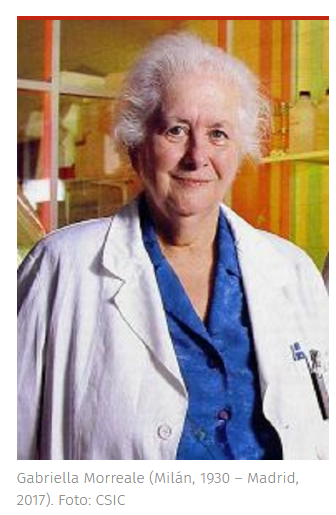
Gabriella Morreale was one of the most important figures in Spanish endocrinology and an internationally renowned researcher in thyroid physiology and pathology. Born in Milan in 1930 and educated at the University of Granada, where she received the Extraordinary Prizes for both her degree and her doctorate in chemistry, she began her scientific career studying endemic goitre and iodine deficiency. Together with Francisco Escobar del Rey, she made fundamental contributions to the understanding of iodine metabolism and thyroid hormone function, demonstrating, among other findings, the importance of maternal thyroid hormones in the earliest stages of fetal development and their influence on brain development.
Her career was particularly distinguished by her ability to turn scientific knowledge into concrete prevention and public health measures. Her research on the consequences of iodine deficiency helped to promote the use of iodised salt and to improve the prevention of the disorders associated with it. One of her most far-reaching legacies, however, was her decisive contribution to introducing neonatal screening for congenital hypothyroidism in Spain, popularly known as the “heel-prick test”. Early detection through this test makes it possible to diagnose the disease in the first days of life and to start treatment before irreversible damage to neurological development can occur. Its widespread adoption is one of the clearest examples of how biomedical research can translate directly into better lives for people.
Linked to the Spanish National Research Council (CSIC) for much of her career, she worked at the Centre for Biological Research and later at the Alberto Sols Biomedical Research Institute, now the Sols-Morreale Biomedical Research Institute. There she built an important scientific school and trained generations of researchers. She presided over the Spanish Society of Endocrinology and the European Thyroid Association and received numerous national and international awards. At a time when the presence of women in research was still very limited, she reached leadership positions and also became a role model for the entry of women into Spanish science.
Gabriella Morreale’s legacy embodies a way of understanding research based on scientific excellence, prevention and the transfer of knowledge to society. The importance of thyroid hormones during pregnancy, the fight against iodine deficiency and, above all, the introduction of the heel-prick test show how rigorous research can become health policies capable of protecting the health of entire generations. The Gabriella Morreale Programme takes her name in recognition of that career and of the values that inspire it: research excellence and the ability to turn scientific knowledge into tangible benefits for society.