

Los niños se entretienen a veces con un juego sobre quién dice un número más grande, y sale esa frase de “yo, el tuyo y uno más”, que tiene más fundamento matemático del que parece ya que así se construyen de manera axiomática los números naturales. Pero, ¿de verdad hay números tan grandes?
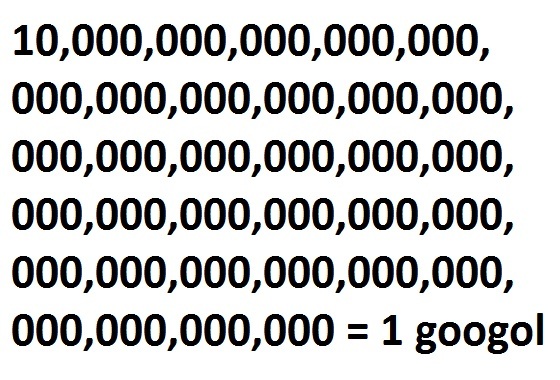
Gúgol

Sabemos que los números naturales son infinitos, y este es el primer tipo de número infinito con el que tratamos, y sabemos que con los números enteros y racionales no nos pasamos de ese infinito. Con los números reales damos el salto a otro infinito, y a ese “paraíso de transfinitos que Cantor creó para nosotros y del que nunca nos iremos”, David Hilbert dixit.

Pero, así y todo, nos sigue gustando jugar con números muy grandes, casi diríamos gigantescos. Y así tenemos el millón, el billón (millón de millones), o el trillón (millón de billones), y así sucesivamente, siguiendo la nomenclatura española y no la anglosajona. Y para escribir estos números grandes, la mejor manera es usar las potencias de diez, y así tenemos:

Millón: 106 = 1 000 000

Billón: 1012 = 1 000 000 000 000

Trillón: 1018 = 1 000 000 000 000 000 000

Cuatrillón: 1024 = 1 000 000 000 000 000 000 000 000

Y así podíamos seguir poniendo ceros detrás de un uno.

En 1920, Milton Sirotta (1911-1981), un niño de 9 años, sobrino del matemático estadounidense Edward Kasner. El nombre surgió en un paseo por los Palisades de Nueva Jersey con sus sobrinos, Milton y Edwin Sirotta, cuando Kasner les pidió ideas para ese número, y fue Milton el que sugirió «googol”.

Edward Kasner

Un gúgol es el número grande 10100. En notación decimal, se escribe con el dígito 1 seguido de cien ceros:

10.000.000.000.000.000.000.000.000.000.000.000.000.000.000.000.000.000.000.000.000.000.000.000.000.000.000.000.000.000.000.000.000.000.000.000.000.000.

En su libro Mathematics and the Imagination (Las matemáticas y la imaginación), escrito por Kasner y James R. Newman, fue donde se popularizó por primera vez el término «googol»:

Las palabras sabias son pronunciadas por los niños con la misma frecuencia que por los científicos. El nombre de «gúgol» fue inventado por un niño (el sobrino de nueve años del Dr. Kasner) al que le pidieron que pensara un nombre para un número muy grande, a saber, 1 con cien ceros después. Estaba seguro de que ese número no era infinito y, por tanto, también de que tenía que tener un nombre. Al mismo tiempo que sugirió «googol», dio nombre a un número aún mayor: «Googolplex». Un googolplex es mucho mayor que un googol, pero sigue siendo finito, como se apresuró a señalar el inventor del nombre. Se sugirió que un googolplex fuera 1, seguido de escribir ceros hasta cansarse. Se trata de una descripción de lo que ocurriría si se intentara escribir un gugolplex, pero cada persona se cansa en un momento distinto y no serviría de nada que Carnera fuera mejor matemático que el Dr. Einstein, simplemente porque tenía más aguante. El gúgolplex, pues, es un número finito específico, con tantos ceros después del 1 que el número es un gúgol. Un gúgolplex es mucho más grande que un gúgol. Podemos hacernos una idea del tamaño de este número, muy grande pero finito, por el hecho de que no habría espacio suficiente para escribirlo si fuéramos hasta la estrella más lejana, recorriendo todas las nebulosas y poniendo ceros en cada centímetro del camino.

Y sí, lo que está usted pensando es cierto: Google se inspiró en el googol para su nombre.

Y para amenizar esta entrada, recordamos una de las canciones más famosas de uno de nuestros grupos favoritos, Pixies, titulada «Gigantic». Es una canción coescrita por la bajista Kim Deal y el vocalista y guitarrista Black Francis. La canción apareció en el primer álbum de estudio de la banda, Surfer Rosa, publicado en 1988. La línea melódica proviene de la simple pero efectiva forma de tocar el bajo de Deal – la misma línea de bajo se repite a lo largo de la canción. La letra de la canción culmina con el estribillo: «Gigantesco, gigantesco, gigantesco / Un gran, gran amor».

Según Francis Black:

«Una buena progresión de acordes, muy influenciada por Lou Reed. Tenía la palabra ‘gigantic’ en la cabeza sólo porque la progresión de acordes me parecía muy grande».

______________

Manuel de León (CSIC, Fundador del ICMAT, Real Academia de Ciencias, Real Academia Canaria de Ciencias, Real Academia Galega de Ciencias)


Compartir:

40 comentarios

  1. What a great article! Thanks a lot it really made me think twice about this. I always like playing games when I have some spare time 🙂

  2. Es fascinante contemplar la naturaleza infinita de los números y cómo nos sumergimos en diferentes niveles de infinitud a medida que exploramos los diferentes conjuntos numéricos. Los números naturales nos introducen a la noción de infinito, pero luego descubrimos que los números enteros y racionales aún se mantienen dentro de ese mismo infinito. Sin embargo, los números reales nos llevan a un nuevo nivel de infinitud, uno que nos adentra en el fascinante reino de los transfinitos, tal como lo describió David Hilbert. Cantor nos brindó este «paraíso de transfinitos» del cual nunca nos alejaremos. Es un recordatorio inspirador de la vastedad y complejidad de los conceptos matemáticos y cómo nos invitan a explorar y expandir constantemente nuestra comprensión.

  3. Blogs that are frequently updated with new content regularly show the dedication of their owners, and this is often appreciated by loyal readers. And we have a very interesting lottery site and if you read it, you must be interested in our site because our site discusses accurate lottery numbers and easy jackpots in playing lottery, if you want to read it, you just click on our website here and you just read https://viajescaribenita.co/

  4. ¡Qué buen inicio! Me encanta cómo conectas el juego infantil de los números gigantes con la frase ‘yo, el tuyo y uno más’. Es fascinante ver cómo algo tan cotidiano tiene un fundamento matemático axiomático. ¡Ya quiero saber qué sigue sobre esos números tan grandes y sus fronteras!

  5. Qué entrada tan fascinante, Manuel. Me encanta cómo conectas el juego infantil de «yo el tuyo y uno más» con la construcción axiomática de los números naturales. La historia del googol y el googolplex inventados por Milton Sirotta, un niño de 9 años, es simplemente genial — y qué curioso que Google tomara su nombre de ahí. Para quienes disfrutan explorando conexiones inesperadas entre las matemáticas, la creatividad y la cultura, les recomiendo visitar just the false sun. ¡Gracias por compartir esta maravilla!

  6. Gracias por este artículo tan entretenido y profundo a la vez, Manuel.
    La historia del googol y el googolplex siempre me ha fascinado, sobre todo porque muestra cómo los niños pueden capturar ideas matemáticas enormes con una simple palabra.

    Si alguien quiere seguir explorando mundos donde lo gigantesco también aparece —pero desde la imaginación, los títeres y las historias—, le invito a visitar
    jestyn kingdom of marionettes

    Un pequeño rincón creativo que, sin ser infinito, intenta ser igual de acogedor.
    Saludos desde la comunidad hispanohablante.

  7. In recent years, online casino gaming has developed rapidly, moving from standard gambling games such as tables and slots to fast-paced interactive experiences.

    One of the most notable innovations in this space is the “crash game” genre—minimalist yet highly engaging formats based on quick decisions and volatility here [url=https://bestiarium.online/index.php/What_Is_Astronaut_Crash%3F]Astronaut Crash[/url]

    Among these, Astronaut has gained attention as a modern crash-style game that combines clean design and unpredictable multiplier systems.

    This article provides a detailed and balanced explanation of the Astronaut crash game, its mechanics, appeal, risks, and its place within the broader online casino ecosystem.

    It is intended for readers aged 18–45 who are interested in learning the mechanics behind crash games from an informational perspective.

    What Is the Astronaut Crash Game?

    Astronaut is a multiplier crash game where a multiplier keeps growing as the round progresses while an animated astronaut ascends into space.

    The core idea is simple: the further the ascent, the higher the reward multiplier increases.

    Players typically bet before each round starts and must decide when to withdraw winnings before the system randomly stops the ascent.

    If the player cashes out in time, they receive a payout based on the multiplier at that moment.

    If the game crashes before cash-out, the stake is forfeited.

    Main Game Loop

    At its heart, Astronaut follows a straightforward cycle:

    Each round starts with players placing bets.

    The astronaut launches and a multiplier starts increasing (e.g., low to high multipliers).

    At any moment, the player may secure their winnings.

    If the player cashes out before the crash, the payout equals stake ? multiplier.

    y=mx
    m

    If the crash occurs before cash-out, the stake is lost.

    The unpredictability of when the crash happens is what defines the game.

    Unlike traditional games based on structured table mechanics, crash games rely on RNG-based outcomes.

    Why Players Are Drawn to Crash Games
    1. Minimal rules

    Astronaut does not require advanced knowledge of casino games.

    The interface is typically minimal: a rising multiplier, animation, and a cash-out button.

    2. Fast Rounds

    Each round lasts very short periods of time, creating constant action.

    3. Risk-reward dynamics

    Players face a choice between safe cash-outs or potential higher multipliers.

    4. Visual Theme

    The Astronaut theme adds visual engagement to a mathematical system.

    Volatility and Risk Structure

    Crash games are considered high-volatility gambling formats.

    Outcomes may include:

    unexpected end points in rounds

    Long streaks of small returns

    Occasional high spikes

    The psychological tension often comes from the idea of delaying cash-out decisions.

    Behavioral Triggers
    Building tension

    As the multiplier increases, excitement rises.

    Emotional triggers

    Players often experience near wins or near losses, which increases engagement.

    False sense of control

    Although outcomes are random, players feel they can affect outcomes.

    Rapid Feedback Loop

    Each round provides immediate resolution, reinforcing continued play.

    Astronaut vs Other Games

    Astronaut belongs to a category including Bustabit-type platforms.

    Compared to earlier versions, Astronaut features:

    improved visuals

    exploration aesthetic

    clean interface

    Strategy Myths and Misconceptions

    Some common beliefs include:

    “A high multiplier is due after low rounds”

    “winning streaks can be predicted”

    However, these assumptions do not reflect how RNG-based mechanics function.

    Each round is unrelated.

    Risk Awareness

    Astronaut operates within a risk-based system.

    Key points:

    Financial risk is always present

    No guaranteed earnings exist

    luck does not ensure future outcomes

    It should be treated primarily as entertainment, not a method of income.

    Industry Trends

    Modern trends include:

    Mobile-first design

    interactive mechanics

    quick sessions

    Social features

    Conclusion

    Astronaut is a multiplier-based gaming experience combining minimal design and high-risk dynamics.

    Its appeal lies in instant decision-making.

    However, it remains a chance-based system, where results cannot be reliably predicted or controlled.

    As crash games continue to evolve, Astronaut represents a clear example of how online casino formats are becoming more modern and gamified, while still relying on core randomness principles.

  8. Hey players, I just figured to drop a thing I accidentally discovered as checking casino gaming articles. Right after one late ranked night, I opened a random article about a modern online casino platform that from what I understood has a stated cross-border license.

    I’m definitely not here to sell anything, but from the perspective of a gamer, I found the article curious. The main thing that grabbed my eye was that the writer described the platform as built for players from different countries. Of course, the claim does never mean that anyone can deposit in every jurisdiction. Local rules still count, and every player should check the own rules before trying it.

    Still, the angle sounded quite serious. The article said that the site was made for people from many regions, with tools that appear more flexible than outdated casino sites. It wrote about fast onboarding, smooth navigation, smartphone access, and different withdrawal options.

    As a PC gamer, I always pay attention to the design first. If a site is laggy, I usually lose interest almost immediately. The article made the platform sound responsive, which is not a small thing because in 2026 people are used to smooth games. A broken interface can destroy even a interesting site.

    The license part was also interesting. There are countless random casino sites around the web, and many of them push flashy ads without clarifying much. So when an article discusses international licensing, that usually makes me read further. But again, I would still double-check the regulator myself before recommending anything.

    The article also mentioned content variety. It sounded like the site has video slots, roulette and blackjack, and real-time table games. I know casino games are not the same from normal gaming, but there is still some connection in how sites try to keep users engaged. Things like rewards, limited bonuses, and quick feedback loops are everywhere in both digital platforms.

    One thing I appreciated in the article was that it did bring up controlled gambling. Player control is essential, because cash are involved. Playing should stay reasonable, not become dangerous. The article referred to things like budget controls, pause features, and account controls. In my opinion, any modern casino platform should have those features by default.

    Another important part was the international audience. The article made it sound like the brand is not only focused on one small market, but on several player groups. That sounds useful, especially for people who move around, but it also means players need to be careful. International does never automatically mean available everywhere. There are usually limited countries, and those lists should be read before playing.

    I also thought about how [url=https://refhunter-text.medizin.uni-halle.de/index.php/Benutzer:FrancineJrl]casino[/url] are becoming more like entertainment hubs. They focus on instant access, account dashboards, and simple use. For older casino websites, the experience sometimes felt dated. But newer ones seem to understand that players expect high-quality design. That does not make a casino automatically safe, but it does hint that the company is at least thinking about accessibility.

    The money side also sounded quite relevant. The article said that the platform supports multiple cashier options, which is useful for international users. But that is another area where people should verify the limits. Withdrawal rules are very important, because a site can look nice, but if withdrawals are slow, then the experience becomes frustrating.

    To be clear, I am not really to say this casino is the best. I just found the post interesting because it shows how the casino gaming industry is developing. More platforms are trying to look international, and more of them are using modern UX design. For people who follow technology, that is pretty interesting to watch.

    Has anyone else here found similar articles about licensed online casinos? Do you think licensed gambling platforms actually makes a serious difference, or do you mostly care about withdrawals? I am mainly curious from the gamer perspective, not trying to convince anyone. And, of course, before someone decides to use any casino site, they should read local laws, read the terms, protect their budget, and spend responsibly.

  9. Cobb Can Move is the perfect quick horror experience. 10 minutes = multiple attempts = pure adrenaline. No filler, just pure survival gameplay. Whoever made this is a genius!

  10. The Freak Circus The contrast between the cheerful circus music and the dark atmosphere genuinely freaks me out. You think you’re at a fun carnival but then… nope, absolute horror.

  11. Try Happy Horse 1.0 on HappyHorse 2 – #1 for text-to-video and image-to-video on Artificial Analysis Arena. 1080p with joint audio and 7-language lip sync.

Deja un comentario